Collection: Koi Medication & Treatments
Everything you need to keep your koi healthy, in one place. Whether you're fighting a parasite outbreak, healing an ulcer, or simply building a pond first-aid kit, our koi medications cover the conditions hobbyists actually face, from ich, flukes and anchor worm to bacterial ulcers, fin rot and fungus.
New to koi health? Start with the symptom finder below. Match what you can see on your fish to the right treatment. And remember the golden rule: test your water before you medicate. Most "sick" koi are really stressed by their water, and the fix is often a water change, not a bottle.
Shop by condition
Know what you're treating? Jump straight to the right shelf.
What's your koi doing? Find the right treatment.
New to koi health? Start with what you can see. Match the symptom to a card, then pick the treatment that fits.
Before you medicate: test your water first.
The great majority of "sick koi" are really stressed by their water, not by a bug. Ammonia, nitrite, low oxygen and pH swings cause flashing, clamped fins, gasping and even ulcers. A test kit is the cheapest, most useful thing a new hobbyist can own. Fix the water, and often the fish recovers on its own. If readings are clean and symptoms persist, work down the cards below.
You see: koi darting and scratching against rocks, clamped fins, excess slime, or grains of "salt" (white spots) on the skin and fins.
Likely cause: external protozoan parasites such as ich (white spot), costia, trichodina, chilodonella or velvet.
You see: flashing and clamped fins but no white spots, fast or heavy gill movement, koi hanging listlessly, sometimes thin despite eating.
Likely cause: gill & skin flukes (microscopic) or internal tapeworms.
You see: open crater-like sores, raised or missing scales, ragged or receding fins, red streaks in the fins or body.
Likely cause: Aeromonas / Pseudomonas bacteria, almost always following stress or an injury.
You see: cottony tufts on skin, fins or an old wound, often where scales were lost or a parasite bit.
Likely cause: a fungal infection (Saprolegnia), typically secondary to injury or poor water.
You see: flat, disc-shaped lice moving on the body, or whitish thread-like anchor worms sticking out of a red, inflamed spot.
Likely cause: crustacean parasites: Argulus (fish lice) and Lernaea (anchor worm).
You see: a healing ulcer, a graze or missing scales after netting, or a fish you need to hold still to treat or inspect.
Reach for: a topical sealant to protect the wound, a slime-coat aid to reduce stress, plus a koi-safe sedative for hands-on work.
A note on the serious ones: koi showing "pinecone" raised scales (dropsy) or advancing internal infection usually need injectable antibiotics prescribed by a fish vet, and dropsy in particular carries a poor prognosis once the scales lift. When in doubt, quarantine the fish, keep the water pristine, and call us or a qualified koi vet before dosing.
-
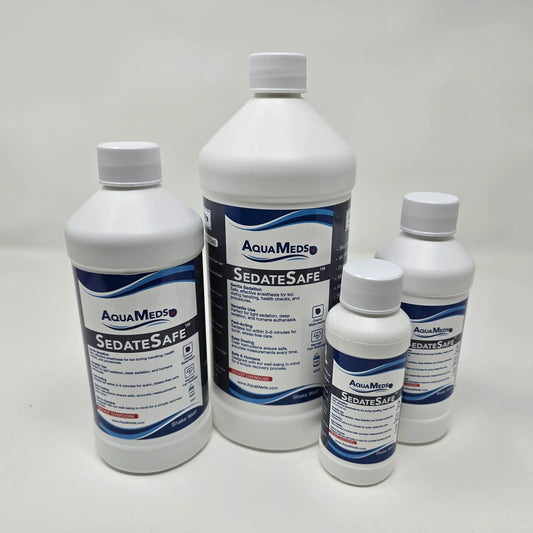
SaleAquaMeds SedateSafe
Vendor:Aqua MedsRegular price From $20.95Regular price$29.99Sale price From $20.95Sale
How to treat koi safely
A quick ingredient guide and the ground rules that keep treatments working and fish safe.
Swipe the table to see the cautions →
| Active ingredient | Treats | Good to know |
|---|---|---|
| Malachite green + formalin | Ich, costia, trichodina, chilodonella, velvet & fungus | The broad first-line parasite/fungus treatment. Don't run it alongside salt. Aerate hard, and use the lower dose on scaleless/doitsu koi. |
| Praziquantel | Gill & skin flukes, tapeworms | Very gentle on fish and the biofilter. The go-to for flukes; often used spring and fall as a reset. |
| Flubendazole | Gill & skin flukes | Long-acting and effective at all temperatures. A strong alternative to praziquantel, especially for stubborn gill flukes. |
| Oxolinic acid / nitrofuran antibiotics | Bacterial ulcers, fin rot, septicemia | Work best as medicated food while koi are still eating. Fix water quality first or the infection returns. |
| Tris-EDTA + neomycin (dip) | Surface ulcers, fin/tail/mouth rot | A short every-other-day dip. Treats external sores only; deep infection also needs medicated food. Don't reuse the solution between fish. |
| Diflubenzuron (ProForm-LA) | Fish lice & anchor worm | Three doses a week apart to catch newly hatched parasites. Safe for scaleless koi, snails and plants at label dose. |
| Tea-tree / bay botanicals (MelaFix, PimaFix) | Mild fin damage, minor wounds, fungus | Gentle, filter-safe support for mild cases and new-fish care, but not a replacement for antibiotics in advanced disease. |
| Aquarium salt | Stress relief, mild parasites, wound support | A useful all-rounder, but don't combine it with malachite-green/formalin treatments. |
Dose by pond volume
Know your true gallons and measure carefully. Under-dosing wastes the treatment; over-dosing can harm the fish.
Aerate hard, turn off UV & carbon
Most treatments lower oxygen, so add an air stone. Carbon and UV strip meds out of the water, so bypass them while treating.
One treatment at a time
Don't stack medications hoping for a faster cure. Some combinations are toxic (salt with malachite/formalin) and layering antibiotics stresses fish and the filter.
Quarantine new & sick koi
A separate tank lets you treat one fish precisely, keep the disease out of the main pond, and observe new arrivals before they join the collection.